|
Mouja
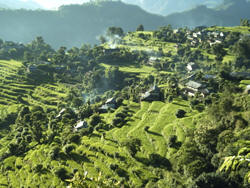
Ecological Organic Farm is situated North
–West of Pokhara City in a beautiful
location. The area of land is almost 12
acres at present which can be extended up to
100 acres. Organic Coffee will be the main
crop in the farm. Beside coffee there will
be other activities such as permaculture,
organic vegetables and livestock. Mr.
Dakshya Bahadur Gurung is taking care of
this farm who is the Member of SADP-Nepal. |
About
Coffee in Nepal
Coffee is the most important
non-alcoholic beverage in the world. The use of
coffee has evolved from the original chewing of
leaves and beans of the plant to relieve pain,
hunger and fatigue to the present sophisticated uses
such as decaffeinated coffee (Njoroge et.al.1993).
From the center of origin in Ethiopia, Arabica
coffee was introduced in Yemen between 15th and 16th
century. Thereafter the species spread to the
Malabar Coast of India and Ceylon in last decade of
17th century. Commercial cultivation was only step
in 1820s following British investment (Poon, 2006).
Food produced through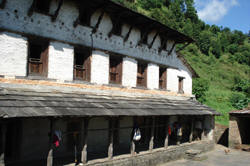 intensive agriculture with application of chemical
fertilizer and pesticides have been contaminated
with toxic chemicals that are hazardous to human
health and caused irreversible damage to soil and
environment. The demand for organically grown food
products is growing rapidly in the global market.
Certified organic coffees are known to fetch
attractive premiums in the international market and
are in good demand in Europe, US and Japan (CCRI,
2000).
intensive agriculture with application of chemical
fertilizer and pesticides have been contaminated
with toxic chemicals that are hazardous to human
health and caused irreversible damage to soil and
environment. The demand for organically grown food
products is growing rapidly in the global market.
Certified organic coffees are known to fetch
attractive premiums in the international market and
are in good demand in Europe, US and Japan (CCRI,
2000).
In 1938, coffee was introduced here in Nepal. Until
early 2000, coffee producers were not very sure of
coffee being a source of income or income generating
crop due to the market problem. However, after the
year 2002, substantial increase in export and also
increase in domestic market consumption to some
extent motivated producers to consider that coffee
as a major income generating crop. Nepal offers a
great scope for production of organic coffee as the
conditions
 in this country are much more favorable. Nepalese
coffee is readily accepted as a specialty coffee in
specific international market. (Shrestha, 2006).
in this country are much more favorable. Nepalese
coffee is readily accepted as a specialty coffee in
specific international market. (Shrestha, 2006).
The area of cultivation under
coffee is increasing each year. The total area and
production during 2003/04 are 925 ha and 217.6 mt.,
respectively (NTCDB, 2004). The coffee processing
plants located in different parts of the country are
running far below their capacity due to inadequate
supply of coffee beans. Due to lack of trained
manpower, the productivity of coffee in Nepal is low
(300 kg. ha-1) as compared to other countries. Lack
of research and unavailability of high quality
saplings of known origin have become major
constraints to increase the productivity and quality
of coffee (Shrestha, 2004). Non-availability of
information on production technology as
 well as lack of dissemination of knowledge among
the general planting community about organic
production are some of the impediments to popularize
the concept in our coffee growing regions.
well as lack of dissemination of knowledge among
the general planting community about organic
production are some of the impediments to popularize
the concept in our coffee growing regions.
Keeping these points in view Sustainable Agriculture
Development Project (SADP) is searching the donor
for the necessary fund to research and development
on "organic coffee farming at Middle Mountains of
Nepal" with the following goal & objectives.
Goal
The standard of living of the
Nepalese hill farmers could be raised through the
expansion of organic coffee farming in farmers'
level.
Specific Objectives
1. To establish and
develop the organic coffee farm/orchard as a
demonstrative site.
2. To train the farmers on "methods of organic input
preparation and utilization".
3. To train the farmers on "organic coffee farming
techniques"
4.To evaluate the cost benefit analysis due to
adoption of organic coffee farming.
5. To evaluate the farmers perception on organic
coffee farming.
6. To disseminate the organic coffee farming
technologies among users.